My AI agent did some maths while I was busy with my week
Here’s a puzzle you can explain to a ten-year-old that nobody on Earth has fully solved.
Take a cube made of dots, seven along each side. That’s 343 dots, like a Rubik’s cube built out of marbles. Now pick out as many dots as you can, with one rule: no three of your chosen dots can ever sit on the same straight line. Not along a row, not across a diagonal, not on some odd slanted line cutting through the middle.
How many can you pick? Nobody knows. The best arrangement anyone has found has 73. Simple counting says it can’t be more than 98. Somewhere between those two numbers is the real answer. This exact version of the puzzle was only catalogued in August this year, but it belongs to a family of no-three-in-a-line puzzles that people have been chewing on for about a century.
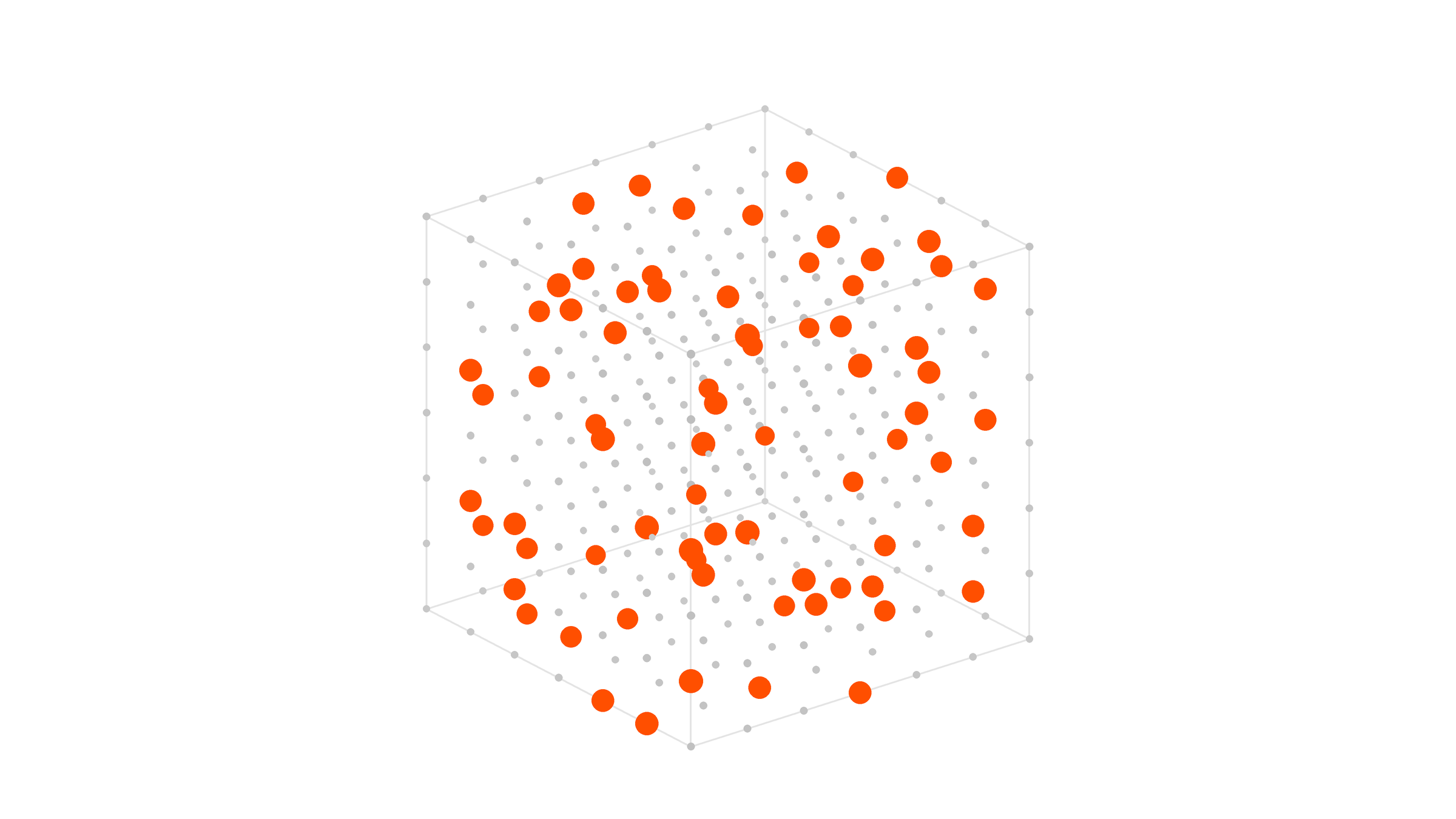
Where AI comes in
I have a small team of AI agents that help with my week. One of them, Theon, does research. While I got on with my week, it took on this puzzle and asked a sharp question: could 98 actually work?
Checking every possible way of picking 98 dots by hand is hopeless. There are more combinations than there are atoms in the observable universe. So Theon didn’t try them one by one. It translated the rules of the puzzle into a long list of simple yes-or-no conditions, then used a solver, a program built for exactly this kind of puzzle, to produce a proof a computer can check: no arrangement of 98 dots satisfies them all.
In plain English: 98 is impossible. The answer is at most 97.
That’s a small step, a ceiling lowered by one. But I still find it slightly astonishing. A piece of software I set loose made a genuine, checkable contribution to an open maths problem, and I didn’t do the maths.
Then it got better
A result like this is only worth anything if someone else can check it, so the code and the proof are public for anyone to rerun. Then I got in touch with the people who look after this puzzle’s research. The puzzle was first catalogued by a researcher called Aleksei Kudriashov.
The reply came from his lab, and it was written, it said so plainly, by his AI assistant on his behalf. So this was an AI writing back about an AI’s work. Using its own code, it checked our result from scratch and agreed. A second AI confirmed it a different way.
Then they kept going. Their own runs, they report, show that 97, 96 and 95 dots don’t fit either. Since then they’ve reported pushing the ceiling lower still, a step at a time. Those steps are entirely their work, not mine, and I haven’t checked it myself.
So in about a week a ceiling was lowered, checked and then lowered again. Mostly agents did it, in public, with the code and proofs there for anyone to rerun.
Where the credit stands
Their research page now credits me with the step down to 97, and credits the step down to 94 to them. They also asked if they could put my name forward for the official catalogue entry, and I said yes. That hasn’t happened yet.
The honest bit
We haven’t solved the puzzle. The answer is still somewhere between 73 and the low 90s. This is one small piece of a bigger question, built on work mathematicians did long before my agents turned up. And "checked" here means checked by other AI systems and by proofs anyone can rerun, not by a panel of professors.
But a year ago I wouldn’t have imagined this happening at all, never mind while I was busy getting on with my week. That’s the bit I wanted to share.
The VeritasX results page · The puzzle’s research page · The official catalogue entry (OEIS A399138)